


Environmental health issues
Ticks and Lyme disease
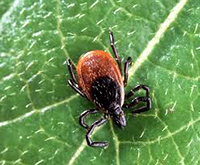 Lyme disease is caused by Borrelia burgdorferi bacteria, transmitted to humans through the bite of an infected black-legged tick. This tick, also called the deer tick, lives in forests and woods, on tall grasses and bushes. Climate change has allowed this species of tick to flourish in Québec. Lyme disease is also present in other Canadian provinces, the United States, Europe and Asia.
Before and during the activity
The objective is to limit direct contact with ticks. It is recommended you:
- wear long clothing;
- apply insect repellent that contains DEET or icaridin, according to the manufacturer’s instructions. Mosquito repellents that contain other ingredients do not keep ticks away (for more information, Gouvernement du Québec);
- stay on maintained trails;
- avoid contact with vegetation.
After the activity or at the end of the day
Since the risk of developing Lyme disease increases once a tick has been attached for more than 24 hours, you must attentively follow these instructions:
- Carefully examine your entire body.
- Examine children’s bodies.
- Examine pets.
- Take a shower or bath (or go swimming).
- Change your clothes.
- Wash your clothes, or put them in the dryer or in the sun.
Even if you didn’t find a tick, watch for redness, fever or other unusual symptoms in the month following the at-risk activity
Think you were bitten by a tick?
To know how to intervene, consult the following link:
You need to act fast because the likelihood of the bacteria being transmitted increases the longer the tick is attached. The transmission risk is very low within the first 24 hours, but increases after that.
Consult a doctor if you develop any symptoms.
TOWN HALL
20410 Lakeshore Road
Baie-D’Urfé, Qc
H9X 1P7
Tel. : 514 457-5324
info@baie-durfe.qc.ca

